No Domain in Shopping Cart
TL;DR
-
A brand strategy is a set of decisions about who you serve, what you're known for, and what you turn down.
-
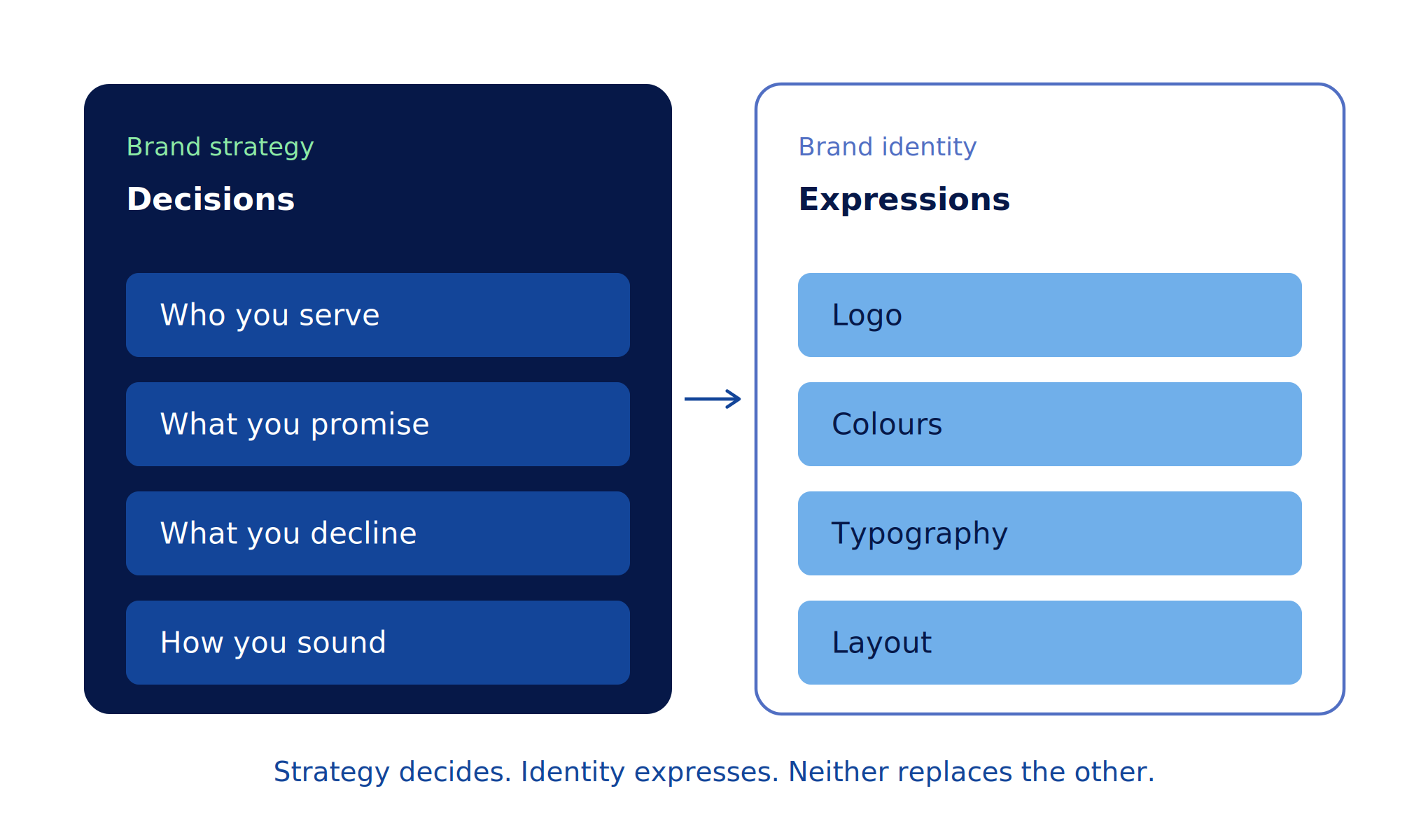
Brand strategy and brand identity are not the same thing. Strategy is the decision; identity is how that decision looks and sounds. This article covers strategy only.
-
Five components are enough for a one-person business: positioning, audience, promise, personality, proof.
-
A positioning statement is specific when it names a client, a problem, and the alternative it beats.
-
Your strategy is working when it changes what you accept, what you decline, and what you put first on your page.
What a Brand Strategy Actually Is
A brand strategy is a set of decisions about who you serve, what you're known for, and what you won't take on. It's a decision framework, not a design file.
Here's where most people get stuck. They treat brand strategy and brand identity as the same thing, so they start with a logo, pick a color palette, and wonder why the result feels generic. Your visuals express your strategy. They can't replace it.
That sequencing error is, in our view, the costliest one a solo operator makes. Paying a designer before you've decided who you're for means paying someone to guess. The output can look good and still fail to sort the right clients toward you. Decide first, then design.
The Five Parts of a Brand Strategy
Five components cover what a one-person business needs:
-
Positioning — who you serve and what you beat. Your competition includes other providers, in-house DIY, and doing nothing at all.
-
Audience — the specific person you're for, not a demographic bracket
-
Promise — the outcome someone gets from working with you
-
Personality — how you sound and behave, expressed in your writing, your emails, and your response times
-
Proof — the evidence that your promise holds
All the items beyond these five: brand architecture, sub-brand systems, internal alignment framework are typically designed for organizations that have a brand department. You do not lose anything by skipping them.
How to Build Each Part on Your Own
Steps 2 through 5 fit in one sitting. Step 1 needs conversations booked in advance, so start there.
1. Interview past clients. Research at your scale means conversations, not market studies. Ask why they hired you, what they'd have done otherwise, and what nearly stopped them. Their words become your positioning language. Three to five people is a reasonable target; small samples surface most of the recurring patterns in qualitative research, and you can add more later.
If you have fewer than five clients, talk to two. If you have none, use the closest evidence available: questions people ask you repeatedly, problems you solved in a previous job, or conversations with people who fit the work you want. Mark these as assumptions and revisit them after your first few projects.
2. Name your audience narrowly. Write down the situation someone is in when they need you. "Small businesses" isn't an audience. "Independent therapists opening a second location" is.
3. Write your promise as an outcome. Not the service, the result. Not "brand photography," but "photos you can post for a year without running out."
4. Define your personality in three words. Pick three you'd defend and three you're deliberately not. Direct, not chatty. Warm, not casual.
5. List your proof. Case studies, results, testimonials, credentials, work samples. If a category is thin, that's your next quarter's priority.
How to Write a Positioning Statement That Isn't Vague
Most positioning statements fail because they describe a category instead of a choice.
Before: "I'm a marketing consultant helping businesses grow through creative digital strategies."
After: "I help independent dental practices fill their new-patient calendar without hiring an agency."
The second names a client, a problem, and an alternative it beats. The first could be anyone's.
Narrow generally beats broad, and it will seem like passing up an opportunity. The exception is in a thin local market where the population might not support getting that narrow. Anywhere else, specificity is easier to quote back — and word-of-mouth works by quoting.
Should You Use Your Name or a Business Name
In case you are delivering your work in person, then your name would be a decent choice to go with. You are the product and in our experience, the business name will not cover up that fact.
The business name should be chosen in cases where you intend to hire people, you want to sell the business later on in life, or the work itself is productized.
The hybrid approach where you use your name for branding and the business name for your documents is the most common route to take.
Where Your Brand Strategy Shows Up First
Your strategy becomes real at the first place people click. For most solopreneurs, that's a bio link, not a homepage.
This page serves as a good test. In a few seconds, the visitor can figure out who you work for, what you do, and how to proceed. If your positioning is not clear enough, then it will be reflected on your page; you will end up with eight links with no hierarchy.
Using your own website address rather than a shared subdomain is worth considering once your positioning is settled. We'd argue a page at yourname.bio signals more intent than a generic link, though both function identically.
How to Tell If Your Brand Strategy Is Finished
A finished brand strategy changes your behavior. Test it against three questions:
-
Can you decline an inquiry using it, without hesitating?
-
Can a past client describe what you do in one sentence?
-
Does it tell you what to put first on your page and what to cut?
If you can't say no with it, it isn't finished. It's still a description.
FAQs
What's the difference between a brand strategy and a brand identity?
Brand strategy refers to a range of choices – whom to target, what to offer, and what not to. Brand identity is the way these choices are communicated through visual and verbal elements such as a company’s logo, colors, and font style. The former is done first since there must be something to communicate.
Do I need a brand strategy if I only have a few clients?
Indeed, and it becomes easier then. Fewer clients mean fewer conflicting demands from you, and hence less expense when you refine your positioning. Start with the facts that you have, identify the areas that require an assumption, and update yourself after working on your next few projects.
How long does it take to create a brand strategy?
It takes two hours for the writing. It will take even more time for the client interviews that form the basis for it because they have to be scheduled. Most individuals working alone should have a viable draft ready in one week’s time.
How often should a brand strategy change?
The positioning and audience need to remain constant for at least a year because if they keep on changing, the recognition being developed will be lost. Proof needs to be updated on an ongoing basis. If one keeps on changing their positioning, then one has not made up their mind yet.
Where does a brand strategy actually get used once it's written?
It is responsible for deciding what to put on your bio page in the first place, what inquiries you take, what you say about yourself in an introductory email, and what you must sacrifice to fit your information into the available space. If it is not influencing these decisions, then it is being left unused. This is the most common way that the document fails.