शॉपिंग कार्ट में कोई डोमेन नहीं
The traditional investment playbook is failing modern investors, but a sophisticated approach to domain portfolio management is quietly generating extraordinary returns for those who understand the mathematical frameworks reshaping digital asset investing.
The domain market reached $2.35 billion in 2025, yet most investors continue using outdated strategies that ignore emerging technology trends and quantitative portfolio optimization methods. This isn't another basic domain management guide filled with generic advice about renewal reminders and basic security measures.
Instead, we're revealing the mathematical frameworks, AI-powered acquisition strategies, and future-proofing techniques that professional domain investors use to consistently multiply their returns. The convergence of artificial intelligence, voice search adoption, and blockchain technology is creating unprecedented opportunities for strategic domain portfolio optimization.
The Proven Domain Portfolio Framework That Maximizes Returns

Strategic domain portfolio management begins with mathematical precision, not gut instinct or random acquisition patterns that characterize amateur investing approaches. This framework mirrors sophisticated investment strategies used by institutional investors, applying portfolio theory principles for predictable, scalable returns.
The 40% Premium Foundation (Stability Engine)
Your portfolio's stability engine focuses on short, memorable .com domains with established traffic patterns, existing backlink profiles, and proven search engine rankings. These domains typically provide value appreciation potential while offering dividend opportunities through strategic development or parking revenue, though actual returns vary significantly based on domain quality, market conditions, and development strategies. The key criteria include domains under 10 characters, single-word or compound terms with commercial intent, and existing organic traffic that validates market demand.
The 40% Emerging Opportunities (Growth Engine)
Your growth engine consists of emerging niche TLDs that target specific industries before mainstream corporate adoption drives prices beyond reasonable acquisition costs. Industry-specific extensions like .TECH are showing strong adoption among tech startups , while .ai, .health, and .finance domains command premium prices as their respective sectors mature. These domains offer significant return potential as businesses increasingly recognize the branding advantages of industry-aligned top-level domains.
The 20% Moonshot Portfolio (Innovation Engine)
The innovation engine represents your highest-risk, highest-reward allocation including blockchain domains (.crypto, .eth), voice-optimized domains, and alternative cc TLDs like .cc, .cx, .la, and .nu that are positioned to fill market gaps . These investments carry substantial return potential with correspondingly higher loss probability, requiring careful position sizing and systematic risk management.
Portfolio Rebalancing Framework
Quarterly rebalancing using acquisition cost versus current valuation metrics ensures your portfolio maintains optimal allocation ratios. Systematic tracking helps identify winners, cut losers, and optimize overall strategy through data-driven decision making rather than emotional attachment to underperforming assets.
How AI Tools Are Revolutionizing Domain Acquisition and Valuation

Artificial intelligence has fundamentally transformed domain acquisition from manual research to systematic, data-driven strategies that identify high-potential domains before they become obvious to manual investors. AI tools now analyze market trends, competitor domains, and SEO metrics to identify domains with the highest investment potential, providing significant competitive advantages in acquisition timing and valuation accuracy.
Machine Learning Valuation Systems
Advanced systems process thousands of data points, including keyword search volume trends, competitor domain portfolios, social media mention patterns, and patent filing activities to predict domain value appreciation before market recognition drives prices higher. These tools consider factors like pronunciation difficulty for voice search optimization, brandability scores based on linguistic analysis, and trademark conflict probability across global databases.
Automated Opportunity Detection
AI-powered domain selection analyzes business attributes and market trends while cross-referencing social media handle availability, patent filing patterns, and venture capital investment flows to identify acquisition opportunities. Real-time monitoring systems can process thousands of expired domains daily, scoring each opportunity based on historical performance metrics and market timing factors.
Implementation Strategy
The most effective investors combine multiple AI platforms to cross-validate recommendations, using tools like Name Bio for historical sales analysis, Expired Domains.net for expired domain monitoring, and custom scripts for social media handle availability checking. Cost-benefit analysis typically shows significant improvement in acquisition success rates when AI tools guide domain selection compared to manual research methods.
Voice Search Domain Optimization: The 2025 Competitive Advantage

Voice search adoption is reshaping how users interact with digital content, creating significant value advantages for domain names optimized for natural speech patterns and pronunciation clarity. Voice search optimization is increasing demand for easily pronounceable domains as smart speakers and voice commerce platforms become primary interfaces for information discovery.
Pronunciation-First Selection Criteria
Simple, easy-to-pronounce domains align with voice search patterns while complex terms, hyphens, numbers, and homophones create confusion for voice assistants. Successful voice-optimized domains pass the "phone test" – they can be clearly communicated and accurately understood during phone conversations without spelling requirements.
Natural Language Domain Architecture
Short, memorable domain names are taking priority over keyword-heavy options as voice assistants favor concise, clear responses that users can easily remember and repeat. Domains that align with natural speech patterns like "near me" queries, "how to" questions, and direct product requests capture more voice traffic than technically optimized alternatives.
Technical Voice Optimization
The technical infrastructure supporting voice search optimization includes schema markup implementation for voice assistant recognition, page speed optimization for rapid voice search result delivery, and mobile-first indexing alignment with voice search behavior patterns. Voice commerce growth projections suggest that domains optimized for spoken interaction will command premium values.
Beyond Basic Security: Advanced Domain Portfolio Protection Strategies
Professional domain investors implement sophisticated, multi-layered security protocols that provide enterprise-grade protection against evolving cyber threats targeting high-value digital assets. Basic security measures like two-factor authentication and domain locks provide insufficient protection against sophisticated attacks including DNS hijacking and social engineering scams .
Multi-Layered Security Architecture
Advanced security architecture requires systematic implementation of DNSSEC to prevent domain traffic redirection attacks, registry locks requiring manual verification for changes, and dedicated secure email addresses for domain management. These technical measures create multiple verification checkpoints that significantly increase the difficulty for attackers attempting unauthorized domain transfers.
Access Control and Compliance
Role-based access control for team environments and external contractors ensures that no single individual can compromise entire portfolios while maintaining operational efficiency. DMARC implementation requirements and stricter regulations add additional compliance layers that protect both domain assets and associated email infrastructure.
Recovery and Continuity Planning
Business continuity planning includes backup DNS configurations, emergency contact procedures, and alternative access methods that maintain business operations during security incidents. The investment in comprehensive security infrastructure typically represents a small percentage of total portfolio value but provides protection against losses that could eliminate years of investment gains.
Web3 Domain Integration: Positioning Your Portfolio for the Decentralized Future
Blockchain-based domains represent the next evolutionary step in digital ownership, offering permanent ownership rights, censorship resistance, and seamless integration with Web3 applications. Decentralized domains (.crypto, .eth) offer enhanced security and censorship resistance while operating without centralized registries, creating true ownership models where domain holders control their assets without ongoing renewal fees.
Understanding Decentralized Domain Architecture
Blockchain domains function as both web addresses and payment addresses, enabling users to send cryptocurrency payments to human-readable names instead of complex alphanumeric wallet addresses. This dual functionality creates utility value beyond traditional domain speculation, as Web3 domains become essential infrastructure for decentralized finance applications and NFT marketplaces.
Strategic Integration Approach
Strategic integration approaches for existing domain portfolios consider blockchain domains as part of the higher-risk moonshot allocation, focusing on cross-platform compatibility considerations and wallet integration capabilities, though specific allocation percentages should be determined based on individual risk tolerance and market research. Big buzz around AI, Web3, and emerging market domains is driving value as early adopters recognize competitive advantages before mainstream corporate integration increases acquisition costs.
Implementation Roadmap
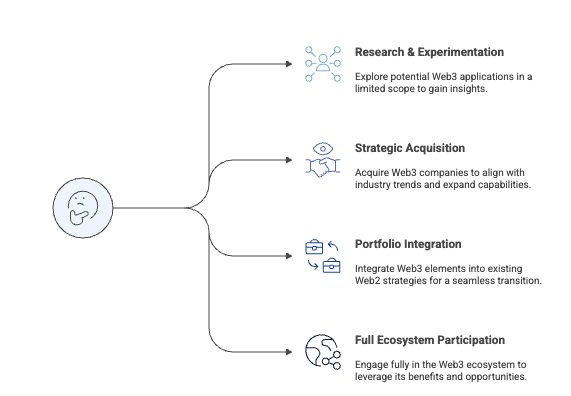
Implementation requires a phased approach:
-
Phase 1: Research and small-scale experimentation (1-2 domains)
-
Phase 2: Strategic acquisition based on industry alignment
-
Phase 3: Integration with existing Web2 portfolio strategy
-
Phase 4: Full Web3 ecosystem participation
Risk management considerations include regulatory uncertainty, technical complexity barriers, and market volatility correlated with cryptocurrency markets that require careful position sizing and ongoing monitoring.
Data-Driven Portfolio Optimization: Measuring and Maximizing Domain ROI
Successful domain portfolio optimization depends on systematic performance measurement frameworks that transform subjective investment decisions into objective, data-driven strategies. Quarterly review cycles tracking acquisition costs versus current valuation provide the foundation for portfolio optimization, enabling investors to identify outperforming assets worthy of increased allocation.
Key Performance Metrics
Professional investors track portfolio carrying costs, renewal ROI calculations, traffic generation metrics for developed domains, and search ranking improvements to maintain comprehensive visibility into portfolio performance across multiple value creation mechanisms.
Strategic Decision Framework
The strategic decision framework requires performance matrix evaluation for hold/sell decisions that considers both quantitative metrics and qualitative market factors. A disciplined approach avoiding sunk cost fallacy in underperforming domains ensures that emotional attachment doesn't prevent optimal capital allocation decisions.
Case Studies: How Strategic Domain Investors Achieved 10x+ Returns
Real-world implementation of systematic domain portfolio strategies has generated documented portfolio transformations that demonstrate the practical effectiveness of these frameworks. These success stories showcase how strategic thinking, systematic acquisition, and long-term vision can create extraordinary returns in domain investing.
Mike Mann: Data-Driven Portfolio Curation Strategy
Mike Mann's approach demonstrates the evolution of successful domain portfolio management from volume-based to quality-focused strategies. His investment methodology emphasizes analyzing data points such as search volume and potential brandability rather than simply acquiring catchy names or relying on intuition.
Mann's strategy has evolved over time to favor quality over quantity, targeting premium, brandable domains that hold long-term value and appeal to larger corporations rather than relying solely on traffic volume. His company, Domain Market, exemplifies this strategic approach through its carefully curated selection of premium domains, demonstrating how systematic curation can differentiate a portfolio in the marketplace.
Beyond domain acquisition and sales, Mann recognized the importance of accurate domain valuation and founded Accurate Appraisals.com to address market needs for comprehensive domain appraisals. This vertical integration into domain services illustrates how successful portfolio managers often build supporting businesses that enhance their core domain operations while serving the broader industry.
Frank Schilling: Accidental Growth Through Systematic Acquisition
Frank Schilling's domain investing journey illustrates how passion and systematic acquisition can create extraordinary opportunities, even when entering the market after many premium domains were already registered. Starting domaining in 2001, Schilling described his portfolio growth as "accidental" but driven by genuine passion for naming, growing gradually from one domain to thousands through consistent acquisition.
A notable early success demonstrates both his systematic approach and the potential for miscommunication to create windfall profits: Schilling had acquired 10 related construction and building supply domain names over time and contacted James Hardie, an Australian company, arranging to sell them for $10,000. After transferring the domains first, he received a wire transfer for $100,000. When he called to report the apparent error, the company clarified they had agreed to "$10,000 per name" rather than $10,000 total, turning what he thought was a $10,000 sale into a $100,000 transaction that validated his systematic approach to acquiring related domain clusters.
These documented success stories demonstrate that extraordinary returns in domain investing come not from luck or speculation, but from systematic acquisition strategies, deep market understanding, and the patience to hold quality assets until optimal monetization opportunities arise.
Start Your Domain Portfolio Transformation Today
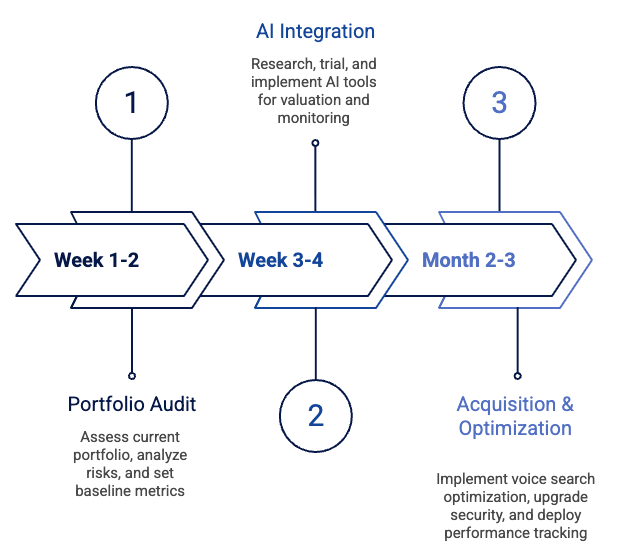
Begin your domain portfolio optimization immediately with a systematic audit using the 40/40/20 framework, followed by AI tool integration and voice search optimization implementation over the next 90 days.
The systematic approach outlined in this guide provides a proven framework for domain portfolio optimization that addresses critical gaps in traditional domain investing strategies while positioning portfolios for future technology trends and market opportunities. Implementation requires discipline and systematic execution, but the potential returns justify the effort investment for serious domain investors committed to optimizing their portfolio performance.
अक्सर पूछे जाने वाले प्रश्न
Which AI tools should I use for domain acquisition and valuation?
Start with free tools like Name Bio for historical sales analysis and Expired Domains.net for expired domain monitoring, then consider paid platforms that offer predictive analytics and trademark conflict detection.
The most effective approach combines multiple AI platforms to cross-validate recommendations rather than relying on a single tool, with cost-benefit analysis typically showing significant improvement in acquisition success rates.
How do I optimize my domains for voice search without rebuilding my entire portfolio?
Focus on pronunciation clarity when acquiring new domains - they should pass the "phone test" where you can clearly communicate them verbally without spelling requirements.
For existing portfolios, prioritize development of domains that are already voice-friendly and consider strategic sales of domains with hyphens, numbers, or complex spellings that perform poorly in voice search scenarios.
What security measures are most critical for protecting a growing domain portfolio?
Implement DNSSEC to prevent traffic redirection attacks, enable registry locks requiring manual verification for changes, and use dedicated secure email addresses for domain management separate from your general business email.
For portfolios over 50 domains, consider consolidating with a single enterprise-grade registrar and establishing role-based access controls if you have team members managing different aspects of your portfolio.