शॉपिंग कार्ट में कोई डोमेन नहीं
Remember when Motorola brought back the Razr? Not just the phone, but the name that made millions of us feel like we were living in the future back in 2004. That's retro brand revival in action – the art of breathing new life into names, concepts, and designs that once captured our collective imagination.
Retro brand revival isn't just about slapping an old name on a new product. It's about tapping into something deeper: the way our brains are wired to find comfort in the familiar while craving the excitement of the new.
In 2025, when consumers are bombarded with countless brand messages daily, nostalgia has become one of the most powerful tools in a marketer's arsenal. It cuts through the noise like nothing else can.
The numbers back this up. 80% of Gen Z consumers and millennials are looking for brands that resonate with their nostalgia, according to 2025 research – yes, the generation that never lived through the original moments drives much of today's retro revival. They're hungry for the "simpler times" they never experienced, making vintage-inspired names not just relevant, but essential for brands looking to connect on an emotional level.
What Is Retro Brand Name Revival in Modern Nostalgia Marketing?
Retro brand name revival is the strategic resurrection and reinterpretation of names, designs, and concepts from previous decades. But here's the thing – it's not about copying what came before. Smart brands take the essence of what made something memorable and adapt it for today's market.
This isn't a new phenomenon. Fashion has been doing it for decades – think about how many times we've seen 70s styles come back, or how 90s grunge became trendy again. But what's different now is how systematically brands are mining the past for naming gold. They're not just throwing old names at the wall to see what sticks. They're carefully studying what made certain names resonate and why.
The Psychology of Nostalgia Marketing
Our brains are basically time machines. When we encounter something that reminds us of the past – even a past we didn't directly experience – it triggers a complex emotional response. Psychologists call this "anticipatory nostalgia ," and it's incredibly powerful for brand building.
Memory and emotion are linked in ways that marketers are just beginning to understand. A name that evokes positive memories (real or imagined) doesn't just get attention – it gets trust. And trust, as any brand manager will tell you, is the most valuable currency in business.
Why Heritage Naming Drives Consumer Trust & Brand Equity
Let's be honest – consumers are tired. Tired of being sold to, tired of false promises, tired of brands that feel manufactured. Retro names offer something different: they feel like old friends. There's an immediate sense of "I know this" that bypasses our usual skepticism.
This familiarity translates directly into trust. Current research shows 81% of consumers need to trust a brand to consider buying from it . When Polaroid made its comeback, they didn't need to explain what instant photography was or why it mattered. The name carried decades of positive associations. People already had emotional connections to what Polaroid represented – creativity, spontaneity, tangible memories.
The trust factor is especially powerful for younger demographics who associate retro names with authenticity. Almost 80% of Gen Z consumers said that it is more important to buy from trustworthy brands than ever before. In their minds, something that survived from a previous era must have been good enough to remember. It's a kind of social proof that spans generations.
Successful Retro Naming Strategies: Case Studies in Brand Revival
Converse All Stars: Heritage Naming Success Story
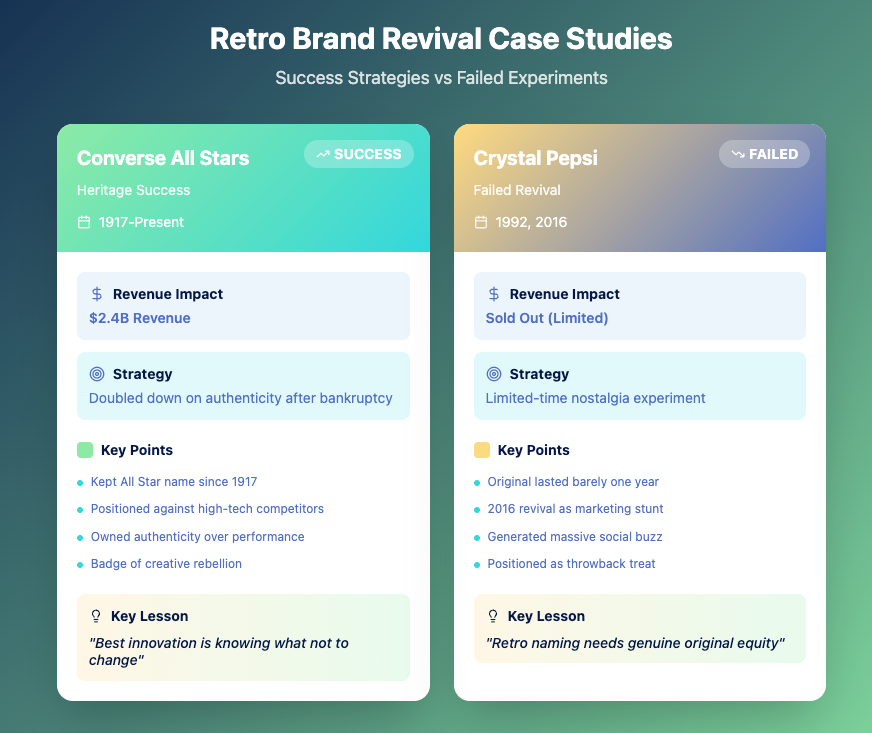
Converse didn't just survive the sneaker wars – they won them by losing first. After bankruptcy in the early 2000s , the brand could have chosen a complete rebrand. Instead, they doubled down on their retro appeal, keeping the "All-Star" name that had been around since 1917.
The genius was in the positioning. While Nike and Adidas fought over high-tech performance features, Converse owned authenticity. The All-Star name became a badge of creative rebellion. Musicians, artists, and anyone who wanted to signal their independence from mainstream athletic culture gravitated toward those distinctive canvas shoes.
Sales numbers tell the story: from near-extinction to $2.4 billion in revenue in 2023, though this represents a recent decline from peak years . The All-Star name was worth more than any new branding could have been. Sometimes the best innovation is knowing what not to change.
Pepsi "Crystal"
Not every retro revival succeeds, and Crystal Pepsi's brief return in 2016 proves the point. Originally launched in 1992 as a "clear cola," it lasted barely a year. The 2016 revival was part nostalgia experiment, part marketing stunt.
दिलचस्प बात यह है कि, the revival generated massive social media buzz and sold out quickly – but it was always positioned as a limited-time throwback. Pepsi understood that some retro names work better as occasional treats than permanent fixtures. The Crystal name carried too much baggage from its original failure to support a serious comeback.
The lesson? Retro naming works best when the original had genuine equity. Crystal Pepsi was memorable for being weird, not for being good. That's not the kind of nostalgia that builds lasting brands.
Step-by-Step Retro Naming Framework for Brand Revival
Identify Nostalgic Cues in Your Target Market
Start with your target audience's formative years – roughly ages 15-25. What was happening culturally during that time? What brands, products, or cultural moments defined that era? Don't just think about your industry; look at music, movies, technology, and social movements.
Current research shows that 54% of Gen Z like the style of vintage clothes , with Google searches for "Y2K" rising since 2021. Create a mood board of names, fonts, colors, and concepts from your target nostalgia period.
Pay attention to naming patterns: Were brands more descriptive? Did they use made-up words? How did they structure compound names? Understanding these patterns helps you create names that feel authentically retro without being obvious copies.
Research trademark databases from your target decades. You'll find expired trademarks and abandoned brands that might spark ideas. Don't steal directly, but understand what kinds of names felt natural and powerful in different eras.
Balance Heritage & Modernity in Vintage Brand Strategy
The sweet spot is names that feel retro but aren't tied to specific failures or negative associations. You want the warmth of nostalgia without the baggage of actual history. Think "retro-inspired" rather than "retro-copied."
Test your name candidates with both older consumers (who lived through the original era) and younger ones (who only know it through cultural references). The name should feel authentic to older consumers and exciting to younger ones. 15% of Gen Z prefer to think about the past rather than the future, making them prime candidates for nostalgic naming. If it only works for one group, keep refining.
Consider how the name will work across different touchpoints. A name that feels perfectly retro in a vintage-style logo might feel outdated in a mobile app interface. The best retro names have enough flexibility to feel at home in any context.
Retro Naming Checklist:
-
Does it evoke the right time period without being too literal?
-
Can both older and younger consumers connect with it?
-
Is it legally available and practically usable?
-
Does it work across digital and physical touchpoints?
-
Will it age well as current retro trends evolve?
Implementing Nostalgia Marketing in Your Brand Strategy
Visual Identity & Packaging for Retro Aesthetics
A retro name without retro-inspired visuals is like a joke without a punchline. The visual identity should support and amplify the nostalgic feelings the name evokes. But here's the crucial part: it shouldn't feel like a museum piece.
Study the design principles of your target era, then apply them with modern techniques and materials. Use color palettes and typography that feel period-appropriate, but execute them with contemporary quality and functionality. Think about how Apple's current design philosophy channels 1960s minimalism without looking dated.
Packaging is especially important for retro brands because it's often the first physical touchpoint consumers have. The package should feel like an artifact from the past that somehow traveled to the present. This creates an immediate emotional connection that pure nostalgia can't match.
Messaging & Launch Campaign for Heritage Brands
Your messaging strategy should acknowledge the nostalgic inspiration without dwelling on it. Consumers should feel the retro connection, not have it explained to them. 92% of consumers feel that nostalgia makes ads more relatable , but the best retro campaigns feel like rediscovering something you forgot you loved.
Plan your launch campaign around the story of revival, not just the product features. Why did this name deserve to come back? What's different about the world now that makes this name relevant again? The narrative should feel inevitable, like this comeback was always meant to happen.
Timeline your rollout to build anticipation. Retro names benefit from a slower reveal that lets the nostalgia build. Tease the name before showing the product. Let people's memories and imagination do some of the work before you show them the reality.
Measuring Success in Retro Brand Revival Campaigns
Key Metrics for Nostalgia Marketing (Brand Recall, CTR, Sales Lift)
Brand recall is your primary success metric for retro naming. Measure both aided and unaided recall, but pay special attention to the emotional associations people have with your name. A high recall rate doesn't mean much if people remember your brand negatively.
Track click-through rates on digital advertising carefully. Retro names often generate high initial CTRs driven by curiosity, but the quality of that traffic matters more than the quantity. Are people clicking because they're genuinely interested, or just because they're confused?
Sales lift is the ultimate test, but don't expect immediate results. Nostalgia-driven campaigns can expect revenue increases of 3-5% per campaign cycle, and retro names often take longer to show their full impact because they're building emotional connections, not just driving transactions. Track customer lifetime value and repeat purchase rates alongside immediate sales metrics.
A/B Testing Tactics
Test your retro name against more conventional alternatives with real advertising campaigns, not just surveys. People often say they prefer familiar, conventional names in research settings but actually respond better to nostalgic options in real-world contexts.
Run creative tests that pair your name with different visual and messaging approaches. Sometimes a retro name works better with modern execution, sometimes with period-appropriate styling. The optimal combination usually surprises everyone involved.
Retro names often have unexpected appeal across age groups and market segments. You might discover secondary audiences that are even more valuable than your primary target.
Conclusion & Next Steps
Retro brand revival isn't just a trend – it's a fundamental shift in how consumers relate to brands. In a world of infinite choice and constant change, names that connect us to simpler times aren't just appealing; they're essential.
The brands that master nostalgic naming will build deeper, more lasting relationships with consumers who crave authenticity in an increasingly artificial world.
The key is balance: enough nostalgia to feel familiar, enough modernity to feel relevant. Get that balance right, and you're not just naming a product – you're creating a bridge between the past people remember fondly and the future they're excited to discover.
Ready to develop your own retro-inspired naming strategy? Start by identifying the nostalgic cues that resonate with your audience, then test and refine until you find that perfect balance of heritage and innovation.
अक्सर पूछे जाने वाले प्रश्न
How do I know if my target audience will respond to nostalgia marketing?
The easiest way is to look at their media consumption and cultural references. If your audience shares 90s memes, watches shows like Stranger Things, or buys vintage-inspired clothing, they're prime candidates for retro naming.
What legal risks come with using retro-inspired names?
The biggest risk is trademark infringement, especially with names that are similar to existing or recently expired trademarks. Just because a brand isn't actively using a name doesn't mean they don't still own the rights to it. Always conduct thorough trademark searches and consider hiring an intellectual property attorney for anything beyond obvious availability.
How long does it take for retro naming strategies to show results?
Retro names often have a two-phase response pattern. You'll typically see immediate recognition and curiosity-driven engagement within the first few weeks. But the deeper emotional connections that drive long-term brand loyalty can take 6-12 months to fully develop.
Can B2B companies use retro naming effectively?
Absolutely, but the approach needs to be more subtle. B2B buyers are often skeptical of anything that seems too trendy or consumer-focused. The key is finding vintage naming patterns that suggest reliability and expertise rather than nostalgia for its own sake.
What's the difference between retro revival and just being outdated?
The difference is intentionality and execution. Retro revival takes the best elements from the past and adapts them for modern contexts. Being outdated means you're stuck in the past without acknowledging how the world has changed.