No Domain in Shopping Cart

TL;DR
-
Google's stance: Google says its search works with both subdomains and subdirectories.
-
Default pick: For most small sites, a subdirectory (yourbrand.com/blog) keeps your SEO effort on one domain.
-
When a subdomain fits: Use one for a logged-in app, a tool that only supports subdomains, or a clearly separate audience.
-
Reporting: A Search Console Domain property covers every subdomain. A URL-prefix property covers one exact address.
-
Migrations: Changing structures can cause temporary ranking swings, so move only with a reason beyond SEO.
Where you put your blog, store, or help center shapes where your SEO effort adds up. Every article you publish and every link you earn builds value somewhere. The question is whether that value lands on your main domain or gets spread across separate sections.
For most small sites, the answer leans one way. Keep content on your main domain in subdirectories, and save subdomains for cases where separation truly helps your users or your tech setup.
What's the difference between a subdomain and a subdirectory?
A subdomain is a section of a website that sits to the left of the root domain. A subdirectory (also called a subfolder) is a section that sits to the right of the root domain, after a slash.
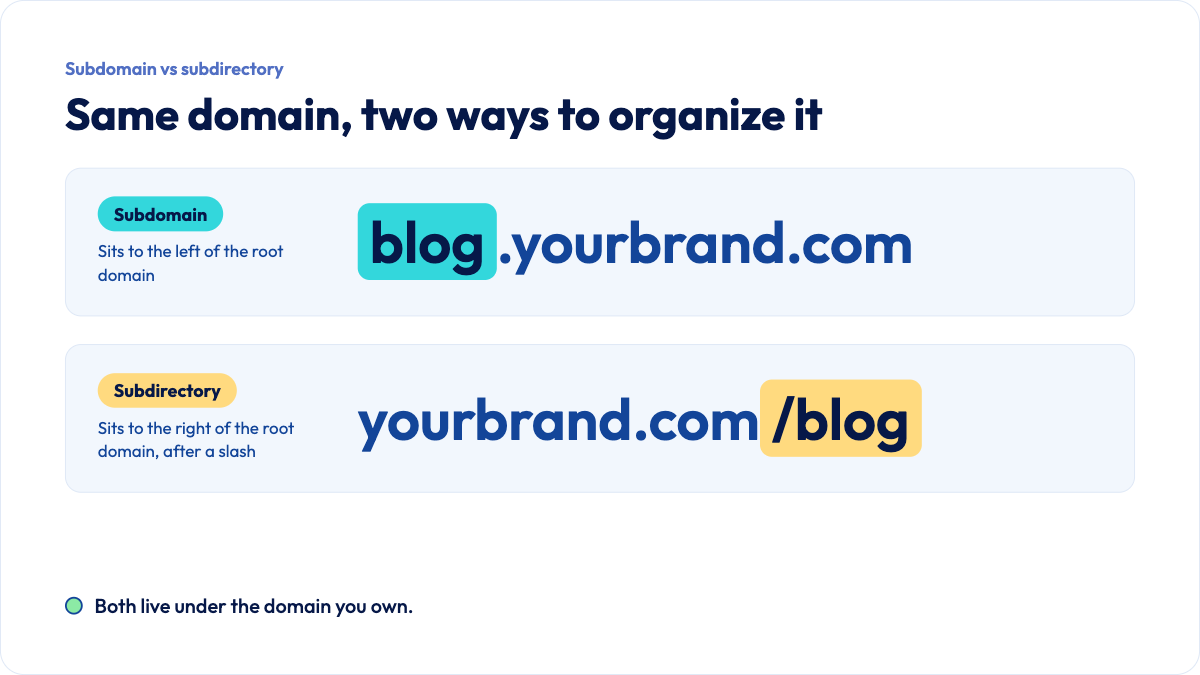
Both live under the domain you own. A subdomain can run on its own server, platform, and settings. A subdirectory is part of your main site's structure. NameClub's own blog, for example, lives in a subdirectory at nameclub.com/blog.
Does Google treat subdomains as separate sites?
Google says its search is fine with either structure. In a Google Search Central video on subdomains and subfolders, John Mueller advises picking the setup that works best for your site and your longer-term plans.
The separation shows up most in reporting. A Search Console Domain property collects data for your domain and all its subdomains and protocols. A URL-prefix property covers only the exact address you enter, so each subdomain (and each http or https version) needs its own property.
Does authority pass between a subdomain and the root domain?
Google hasn't documented exactly how value passes between the two. In practice, links are the connection. Ahrefs notes that a subdomain tied into your main site through internal linking is likely to be treated much like a subfolder. A subdomain with few links to and from your main site has to earn its visibility more on its own.
Why subdirectories are better for SEO on most small sites
Your domain is one asset. When content lives in subdirectories, every backlink and every strong page builds on that single asset.
For a small team, that focus pays off:
-
One property to track: All your performance data sits in one place.
-
One linking system: Internal links connect your pages naturally.
-
Less setup work: There's no extra platform, certificate, or robots.txt file to manage.
Subdomains can rank well too. For a small team, though, each one adds work to the same budget.
Subdomain or subdirectory for your blog, store, app, and help center
A subdomain earns its place when it solves a real problem. Common reasons include a logged-in app that runs on separate tech, a hosted tool that only publishes on a subdomain (some help desk platforms default to help.yourbrand.com), or a section built for a clearly different audience.
|
Use case |
Our pick |
Why |
|
Blog |
Subdirectory |
Content marketing works best when it builds your main domain. |
|
Online store |
Subdirectory |
Product pages benefit from your main site's strength. Use a subdomain only if your store platform requires it. |
|
Web app or dashboard |
Subdomain |
Logged-in pages usually don't need to rank, and apps often run on separate systems. |
|
Help center |
Subdirectory |
Support articles answer real search questions. If your tool forces a subdomain, link to it clearly from your main site. |
When should you use a separate domain instead?
Use a separate domain when you're launching a new brand with its own name, audience, and goals. A standalone name lets that brand build its own identity and reputation from the start.
Choose a name that's short, memorable, and easy to trust. Marketplaces such as NameClub list brandable domains for this kind of launch.
How to move a subdomain to a subdirectory without losing traffic
Only migrate when you have a clear reason beyond SEO, such as simpler management or a site redesign. Google's site move guidance says to expect temporary ranking fluctuation, and a small to medium site can take a few weeks for most pages to move.
Be careful with published success stories too. Many migration case studies also add internal links or ran during a seasonal peak, so the structure change alone can't take the credit.
If you do move, follow these steps: 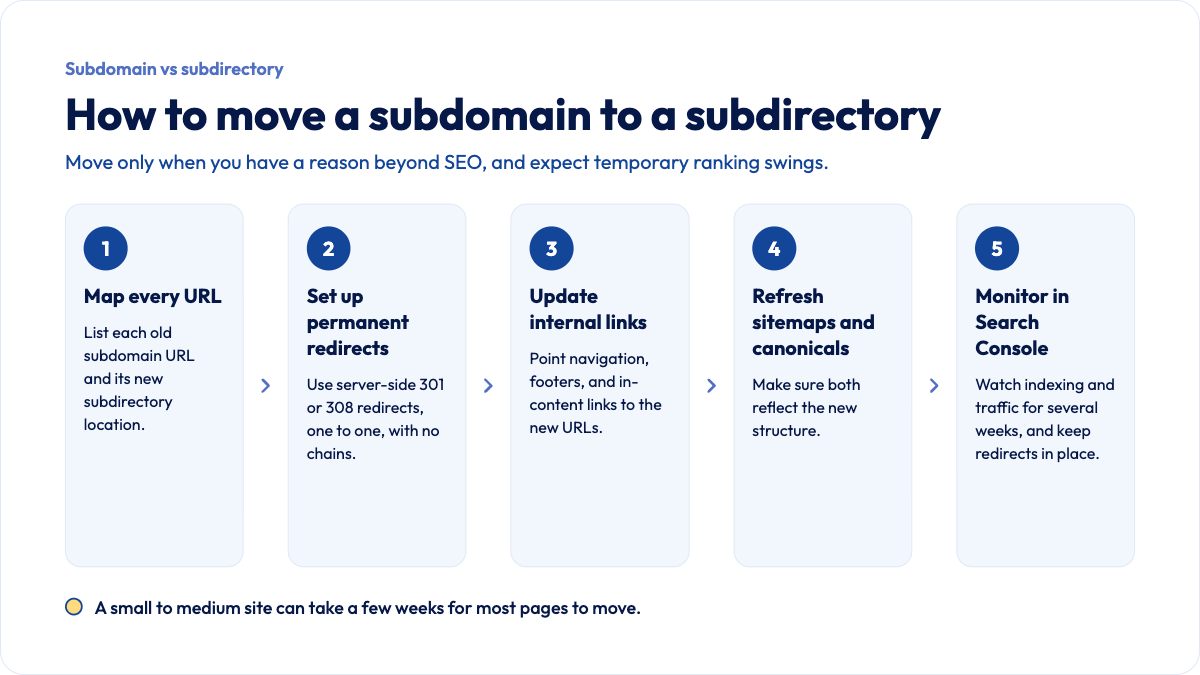
Subdomain vs subdirectory FAQs
Will hosting my blog on a subdomain hurt my SEO?
Google doesn't penalize subdomains, and its search can index both structures. The practical difference is focus: a blog on a subdomain needs strong links to and from your main site to connect with your brand. For most small sites, a subdirectory is the simpler way to build one domain's strength.
Should I move my existing blog from a subdomain to a subdirectory?
Move only if you have a reason beyond SEO, such as simpler management or a redesign. Migrations can cause temporary ranking swings and require careful redirects. If your subdomain is already well linked and performing, a move may add risk without a clear gain.
Is www a subdomain?
Technically, yes. The www in www.yourbrand.com is a subdomain, but most sites use it as the main address, so it isn't treated as a separate section in the usual sense.
Do I need a separate Search Console property for each subdomain?
It depends on the property type. A Domain property covers your root domain and all its subdomains in one place. A URL-prefix property covers one exact address, so you'd need one for each subdomain.
Does a subdomain need its own SSL certificate and robots.txt file?
Each subdomain needs its own robots.txt file, since that file only applies to the host it sits on. For SSL, the subdomain must be covered by a certificate, either its own or a wildcard certificate that includes it.